
Google is testing payments to publishers for content used in AI answers
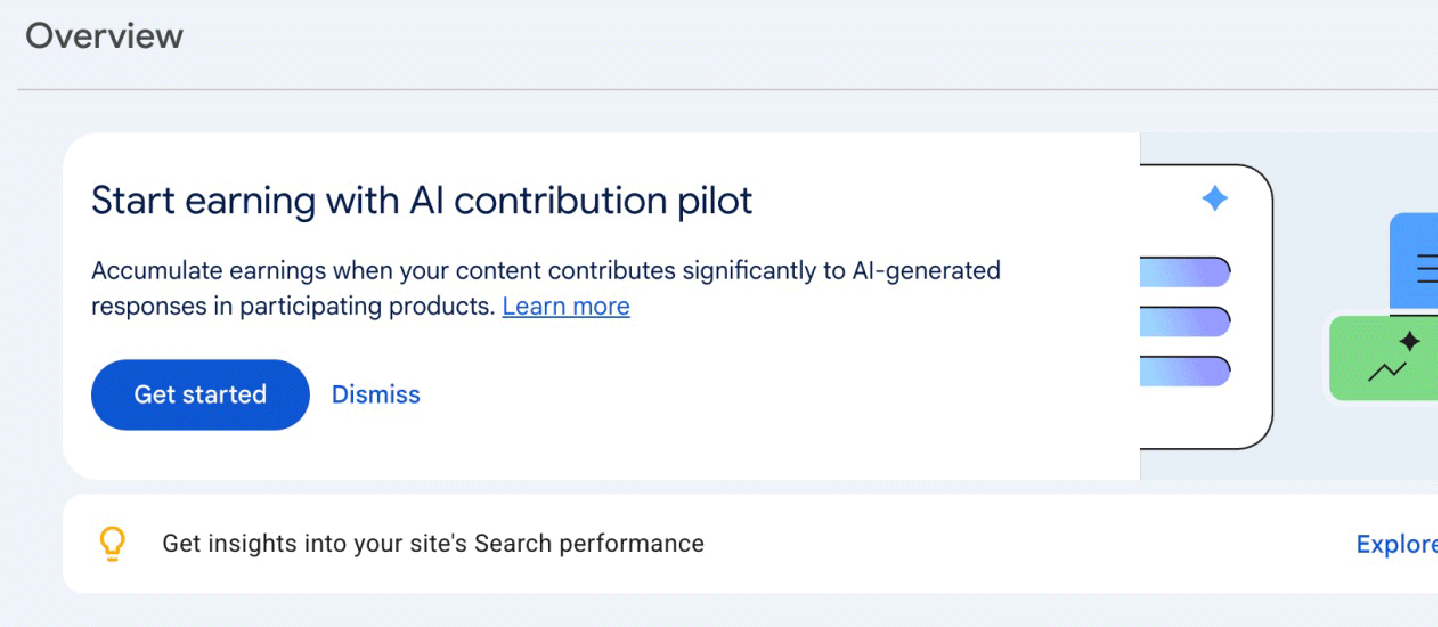
If you publish content online, you have probably wondered whether any of it is worth something to Google now that so many answers come from Gemini, AI Overviews and AI Mode instead of a blue link. Google has started testing an actual answer to that question, quietly, for a small number of publishers.
What it is
It’s called the AI Contribution Pilot. Digiday reported the details on September 14 2026, after Google first quietly added references to it in its own help documentation back in April, spotted at the time by Search Engine Roundtable. Barry Schwartz’s follow-up piece this week ties the two together now that Digiday has confirmed what the pilot actually does.
Publishers accepted into the pilot get paid when Google decides their content “significantly” contributed to an AI-generated response, across Gemini, AI Overviews and AI Mode. This isn’t the traffic-based deal publishers are used to. It’s Google paying for the content itself being used inside an answer, not for sending a visitor to read it.
How it works
Accepted publishers get an AI earnings widget added to their Search Console dashboard. It shows monthly earnings with some historical data, and lets publishers manage payment details and track bank transfers from the same place. They can opt in or out at any time.
The eligibility bar is content that “contributes significantly” to an AI response. Google has said that a page simply confirming a fact, or showing up as a link after the answer is already generated, doesn’t count. Only dozens of publishers have been approached so far, and it’s skewed towards small and mid-sized sites rather than major publishers. For comparison, Google’s existing Google News Showcase licensing program already covers over 2,800 publications in 33 countries, so this pilot is a fraction of that scale.
What we don’t actually know
Google hasn’t explained how it decides what counts as a significant contribution. Publishers in the pilot describe the calculation as a black box. One executive told Digiday the payouts are “lowball numbers” that don’t come close to advertising revenue. Another called the early returns “peanuts.”
That’s not necessarily a sign the whole idea is worthless. One participant framed it as an early test of a marketplace for inference data, useful for understanding what content actually gets used by AI systems, even if the money is small right now. David Buttle, founder of the publisher coalition Spur, suggested to Digiday it may also be a hedge on Google’s part, building the infrastructure it would need if regulators ever force usage-based payments industry-wide. But nobody outside Google can currently explain why one page gets paid and another doesn’t.
Why this is worth knowing about
This is the same shape of problem Bird & Bear keeps running into on the analytics side. Merchant Center’s AI Performance Insights report scores a product feed against what AI shopping tools are actually asking for, without fully explaining its own scoring logic. Google Ads’ new AI Dashboards generate a written explanation for why your numbers moved, without telling you exactly what data went into that explanation. Now there’s a version of the same pattern on the content side: Google deciding what “contributed” to an AI answer, and publishers being asked to trust the number.
If your brand publishes any meaningful amount of content, guides, glossaries, comparison pages, that’s worth watching even if you’re nowhere near being invited into this specific pilot. It’s an early signal of how Google might eventually value content in an AI-first search world, and right now that valuation process is opaque by design, not by accident. Search Engine Land’s Search Console coverage is a good place to watch for whether this expands beyond the current small group.
What to actually do about it
Nothing urgent if you’re not already in the pilot. It’s small scale and the numbers reported so far are not meaningful revenue for anyone. Worth flagging to any client with a content or editorial arm that this exists, so it doesn’t come as a surprise if Google reaches out, and worth remembering the broader lesson: an AI system telling you it valued something is not the same as being able to explain why.
Newsletter
Occasional notes on data, tracking & AI-readiness
No spam, no growth-hacking. Just an email when there's something worth reading.